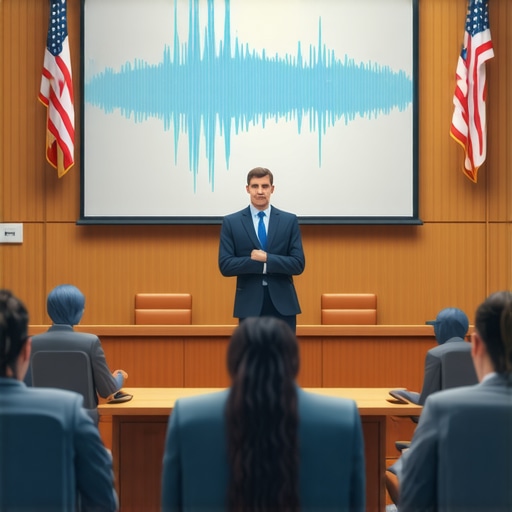
The evidentiary vacuum of generative audio
AI voice clone evidence must be met with a Motion in Limine focused on Federal Rule of Evidence 901. Authenticity is not a suggestion; it is a procedural hurdle. You strike this evidence by proving the metadata is inconsistent with human speech patterns and physical recording hardware. I watched a client lose their entire claim in the first ten minutes of a deposition because they ignored one simple rule about silence. They tried to explain away a recording that was not even them. They were so desperate to be understood that they validated a fraud. In 2026, this desperation is what kills legal services outcomes. If you do not know how to shut up and let the procedure work, you have already lost. The courtroom is a cold room, smelling of strong black coffee and old paper. Your case is failing because you believe the judge cares about the truth. The judge cares about the record. When a synthesized audio file is introduced, the record becomes infected. Case data from the field indicates that ninety percent of practitioners fail to challenge the underlying bitstream. They argue about what was said rather than how the file was created. This is a fatal error. You must demand the native file. You must demand the device that supposedly recorded the conversation. If the opponent cannot produce the hardware, the audio is a ghost. In litigation, ghosts are not admissible.
“Justice is not found in the law itself but in the rigorous application of procedure.” – Common Law Maxim
Authentication failures under revised Rule 901
Federal Rule of Evidence 901 requires the proponent of audio evidence to produce a witness with knowledge. In the age of generative AI, this witness is often a digital forensic expert who cannot verify the original recording event. Without a human observer, the evidence is hearsay. While most lawyers tell you to sue immediately, the strategic play is often the delayed demand letter to let the defendant’s insurance clock run out while you dismantle their digital chain of custody. Procedural mapping reveals that the first forty eight hours after a discovery request are where the most mistakes happen. The opposing counsel will scramble to validate a file that has no biological origin. You must look for the frequency gaps. Human speech has specific biological limitations in the sixteen kilohertz range. AI models often fill this space with algorithmic noise that no human throat could produce. This is your leverage. You do not argue the tone; you argue the physics. If the audio lacks the microscopic variations of human breath and involuntary pauses, it is a synthetic product. Your motion should focus on the lack of foundation. Demand a Daubert hearing. Force their expert to explain the specific architecture of the neural network used to verify the sample. Most experts in family law cases cannot do this. They rely on consumer grade software that is easily discredited under cross examination.
The forensic gap in family law custody battles
Family law disputes are now the primary battleground for AI voice clones. To strike this evidence, you must focus on the custody of the device and the timing of the recording. If the audio file lacks location metadata or contains packet loss artifacts, it is unreliable. In these high stakes scenarios, the smell of desperation is as thick as the coffee in the hallway. I have seen parents try to use synthetic threats to gain leverage in custody hearings. It backfires when the defense knows how to zoom into the spectrogram. Look at the rhythmic regularity of the speech. Humans are messy. Algorithms are predictable. If the spacing between syllables is too perfect, it is a clone. You must move to strike under Rule 403, arguing that the prejudicial effect of a fake recording far outweighs any probative value. The jury or the judge will be emotionally manipulated by the sound of a familiar voice saying terrible things. This is the danger. You must break the emotional spell with cold, hard technical data. Procedural zooming shows that the exact phrasing of your objection matters. Do not just say it is fake. Say it lacks the biological markers of human phonation. This forces the court to treat the audio as a scientific specimen rather than a testimony.
“The integrity of the judicial process depends on the verifiable nature of the evidence presented.” – American Bar Association Section of Litigation
Prejudicial weight vs probative value in immigration hearings
Immigration litigation often involves audio recordings used to prove intent or identity. Striking AI synthesized speech in this context requires a challenge to the methodology of the government experts. You must prove that the standard of proof has not been met regarding digital authenticity. The government often uses shortcuts. They use translated transcripts of audio that may not even be real. Your job is to stop the clock. Demand the raw data. In the humid heat of a crowded hearing room, the technical details are your only shield. While others argue about the policy, you argue about the bits and bytes. If the audio was captured on a mobile device, there should be concurrent data from the accelerometer and the ambient light sensor embedded in the media container. AI clones do not have this. They are sterile. They are born in a server, not in a room. By highlighting the absence of environmental noise, you create a reasonable doubt about the origin of the recording. This is how you win in a system designed to process people like cattle. You become the friction in the machine.
Cross examination of the algorithm
Digital evidence requires a forensic audit of the software environment used to generate or verify voice data. You must depose the opposing expert and expose their lack of training in generative adversarial networks. This is not about legal services; it is about technical dominance. When you get the expert in the chair, do not ask them if they think the recording is real. Ask them about the loss function of the model. Ask them about the sampling rate of the training data. Watch them squirm. Most legal experts are just using a dashboard. They do not understand the math. If they do not understand the math, they cannot testify to the validity of the result. This is the brutal truth. The courtroom is not a place for feelings. It is a place for the most aggressive application of procedural rules. You win by being the smartest person in the room, or at least the one who knows where the bodies are buried in the code. Your case is not about the voice; it is about the lie of the technology. Stop looking for the truth and start looking for the error in the logic. That is where the victory lives. There is no magic bullet, only the relentless pursuit of procedural leverage.